Directors’ report
Directors' report 2025
The Norwegian state holds substantial ownership interests in oil and gas resources, equivalent to about 30 per cent of Norway’s overall oil and gas reserves, as well as in key gas infrastructure on the Norwegian continental shelf (NCS), through the State’s Direct Financial Interest (SDFI). These ownership interests are managed by Petoro AS.
Petoro’s goal is to create the greatest possible value for the Norwegian state from the SDFI ownership interests, as well as to ensure efficient operations and comprehensive development of gas infrastructure. This includes the state’s role as a licensee in production licences, fields, pipelines and onshore facilities.
Cash flow from the SDFI is transferred in its entirety to the Government Pension Fund – Global.
External trends
Over the last few years, the world has been characterised by war, extensive changes and significant security policy tensions. Geopolitical unrest, increased protectionism and trade conflicts contribute to heightened uncertainty and unpredictability. These factors influence and create uncertainty for both the current energy market as well as for progress on the necessary energy transition. This situation was further reinforced by the U.S. and Israel’s attack on Iran on February 28 and the subsequent escalation of the military conflict in the Middle East.
Renewable forms of energy such as solar and wind are growing rapidly at the global level. Electricity use has increased in many sectors, with substantial growth in electric vehicle sales. Global demand for energy has increased despite this transition, alongside the demand for coal, oil and gas.
The International Energy Agency (IEA) expects the demand for energy to continue to rise. Renewable electricity is expected to fulfil a significant share of this need. Most analysis agencies predict that the global demand for oil and gas is approaching a peak, and that we will see a gradual decline within a few years. Nevertheless, extensive investments will be needed in new production to balance the market and offset natural production decline from oil and gas.
Ten years have passed since the international community adopted the Paris Agreement with the aim of limiting the increase in global warming. According to the IEA, international climate cooperation has helped the world avoid the highest temperatures, but current measures are not enough to reach the goals in the Paris Agreement. Greenhouse gas emissions and global temperatures continued to rise in 2025.
Different regions and countries are taking different approaches to the energy transition. Europe, which is our most important market, is facing considerable challenges both as a result of the war in Ukraine, security policy, competitiveness, economics and the climate transition. In recent years, the EU has established an extensive framework for climate and energy, and is continuing its efforts to increase production of its own renewable energy. The objective is not only to reduce greenhouse gas emissions, but also to be less dependent on imported energy, as well as contributing to industrial development and competitiveness. The EU has decided to phase out all Russian gas imports by autumn 2027, and an increasingly larger share of import needs are now covered by LNG, especially from the US. Demand for gas in the EU has declined since Russia’s attack on Ukraine, and is expected to decline further in the years to come. However, the forecasts indicate that there will be a need for gas for many years to come in order to achieve an energy transition at a cost society can accept. Norway has strengthened its position as a reliable and safe energy supplier to Europe in recent years, and is currently the largest single supplier of gas to continental Europe and the United Kingdom.
Gas prices remained relatively stable in the European market in 2025, with a declining trend through the year. Temperatures have been normal, consumption in the various sectors has shown only minor development and LNG has been available on the market. The average gas price at TTF (Title Transfer Facility in the Netherlands) in 2025 was about 4.70 NOK per Sm3. A substantial development of LNG production in the years ahead is expected to result in lower gas prices in Europe.
The oil price has varied between 60 and 80 USD per barrel in 2025. A weakened market balance has driven prices down. Global growth in oil demand was just under 1 million barrels per day, while production increased by about 3 million barrels. This resulted in considerable stockpiling, especially in China, which purchased large volumes of for storage throughout the year. If production significantly outpaces demand moving forward, the price could decline further in 2026. However, major cuts from OPEC+ or other geopolitical factors that affect the supply side could change this picture.
Activity is high on the NCS, both in operations, projects and exploration. A number of projects under development will contribute production, revenue and emission reductions over the next few years. These projects also provide jobs and activity for the supplier industry. This will lay a good foundation for oil and gas deliveries from the NCS and from the SDFI portfolio for a long time to come. However, the cost level has increased, driven by inflation, challenges in supplier chains and trade barriers. Investments are expected to decline moving forward, which could create a challenging situation for the industry.
As oil and gas from the NCS has become increasingly important for European energy security, this has altered the threat scenario for the NCS. The Norwegian National Security Authority (NSM) considers it likely that critical infrastructure in Norway may be exposed to attempted sabotage, and emphasises the need for Norwegian enterprises to reinforce their preventive measures. Operators on the shelf cooperate closely with the authorities on emergency preparedness and security measures associated with infrastructure such as fields, pipelines and cables. The pipelines to continental Europe and the United Kingdom are subject to follow-up and audits vis-á-vis the operator in cooperation with relevant security authorities. Plans have also been established to remediate critical infrastructure following physical or digital incidents.
The number of serious safety incidents on the NCS has remained stable over the last 10 years, but there was a substantial improvement in 2025. Falling objects and personal injuries dominate the range of incidents. The Norwegian Ocean Industry Authority’s annual mapping of the risk level on the NCS shows a positive development. It is important that the industry continues its improvement efforts in order to further reduce the number of serious incidents.
CO2 emissions from petroleum activities on the NCS have been declining since 2015. Production remained relatively stable during this same period. Several fields and onshore plants have decided to electrify using power from shore. Projects are under way on Melkøya, as well as the Troll, Oseberg, Njord and Draugen fields. Electrification will provide substantial emission reductions leading up to 2030. The most cost-effective electrification projects will be first in line. The projects considered to electrify the Halten Bank and Tampen were suspended in 2025 due to high costs, while efforts continue to assess CO2-reducing measures on Balder/Grane and Kårstø. In addition to electrification, energy efficiency measures and measures to consolidate infrastructure are continuously assessed, which will contribute to further emission cuts. Overall, these measures are expected to contribute to emission reductions of nearly 40 per cent, in line with the industry’s own targets.
The player landscape on the Norwegian shelf is changing. At the start of 2025, there were 24 oil and gas companies on the NCS. This is the lowest number since production started up on the shelf. Major international companies have reduced their presence, while the companies on the shelf have also been subject to extensive consolidation. Norwegian companies with a clear focus on oil and gas activities on the NCS have emerged, such like Aker BP and Vår Energi. Equinor remains the dominant player on the shelf and operates about 90 per cent of future SDFI production.
There has been a positive development in applications to study petroleum subjects in recent years, which sends an important signal about interest and access to competence surrounding oil and gas activities.
Summary of SDFI results
Net cash flow to the state from the SDFI at year-end amounted to NOK 243 billion, 23 billion higher than the previous year. The increase in cash flow was primarily caused by higher gas prices and higher tariff revenues as a result of increased ownership in key gas infrastructure. The increase was partly offset by reduced gas volumes, lower oil prices, and higher operating costs. Overall, cash flow in 2025 was the third-highest ever recorded.
Total production reached 1,049 thousand barrels of oil equivalent per day (kboed), a reduction of 15 kboed compared with the previous year.
Gas production amounted to 108 million standard cubic metres (mill. scm) per day, a reduction of four per cent compared with the year before. This reduction was mainly caused by a maintenance shutdown at Hammerfest LNG, as well as lower production from Troll due to capacity issues at Kollsnes. The average realised gas price was NOK 4.86, compared with NOK 4.50 per scm the previous year. Prices were thus higher than in 2024, driven by a tight European gas market, characterised by high LNG competition, robust demand and reduced supplies of Russian pipeline gas.
Liquids production amounted to 366 kboed, a increase of 12 kboed compared with the previous year. This increase was primarily caused by Johan Castberg starting up, as well as higher production from Tyrving and Breidablikk. This was partly offset by natural decline in mature fields and a reduced ownership interest in Heidrun following the ownership swap with Equinor. The average realised oil price was USD 69, compared with USD 82 per barrel the previous year. Measured in Norwegian kroner (NOK), the oil price was 720, compared with NOK 871 per barrel the previous year. This drop in price reflects high global production, tapering growth in demand and increased oil inventories, which overall have led to an oil market in surplus and put pressure on prices.
Investments came to NOK 29 billion, NOK 20 billion lower than the previous year. This reduction was mainly due to the effect of acquiring key gas infrastructure totalling NOK 15 billion, as well as a capital injection of NOK 8 billion in an affiliated company in 2024. Excluding the effects related to the acquisition and the investment in the affiliated company, investments amounted to just over NOK 3 billion higher than the year before. The increase was caused by a higher activity level for Snøhvit Future, and Troll phase 3 stage 2. A larger ownership interest in Gassled also contributed to higher investments in gas infrastructure.
Net income came to NOK 247 billion, NOK 15 billion higher than the previous year. This increase was mainly caused by higher operating revenue as a result of high gas prices, as well as higher tariff revenues as a result of increased ownership in key gas infrastructure. Gains on NOK 23 billion were also recorded for Heidrun in the 1st quarter in connection with a swap agreement with Equinor. The increase was partly offset by lower oil revenue as a result of reduced prices, increased costs and depreciation.
Net income amounted to NOK 4 billion higher than the net cash flow to the state at year-end. The difference between net income and cash flow during this period was primarily caused the accrual of incurred revenue/expenses against paid revenue/expenses.
Total operating expenses amounted to NOK 88 billion, NOK 16 billion higher than the year before. This increase was caused by increased production expenses, expenses to purchase third-party gas, as well as depreciation and impairment.
Production costs amounted to NOK 31 billion, 7 billion higher than the previous year. The increase was mainly caused by increased ownership in key gas infrastructure. Excluding gas infrastructure, production expenses were on par with the same period the year before.
Costs for purchasing third-party gas amounted to NOK 7 billion, NOK 2 billion higher than the previous year. This increase was primarily caused by higher gas prices in combination with increased volumes.
Transport costs amounted to NOK 7 billion, NOK 4 billion lower than the year before. The primary reason for this is that the acquisition of key infrastructure eliminated a significant share of transport costs for fields in the SDFI portfolio.
Total depreciation amounted to NOK 40 billion, an increase of NOK 8 billion compared with the previous year. This increase was caused by higher depreciation for Gassled following the acquisition, Tyrihans following the swap with Equinor, as well as Johan Castberg and Tyrving after first oil on these fields.
The 2025 accounts recognised an impairment of NOK 0.5 billion on Martin Linge, against a reversal of 2 billion in previous impairment in 2024.
The valuation of outstanding forwards in the gas market at year-end showed a net unrealised loss of NOK 0.7 billion. This loss has been allocated in the accounts.
Total exploration expenses during the period came to just under NOK 2.4 billion, of which a net of NOK 0.8 billion has been recognised as capitalised exploration costs. Petoro was a participant in 11 exploration wells in 2025. These resulted in six discoveries. Two are characterised as technical/non-commercial and one is still under evaluation. Dry or presumed non-commercial wells have been expensed.
The book value of assets at 31 December 2025 was NOK 306 billion. The assets mainly consist of fixed assets related to field installations, pipelines and onshore plants, as well as current debtors. Equity at year-end came to NOK 203 billion, which is an increase of NOK 4 billion compared with the year before. The increase was caused by the transfer to the state being 4 billion lower than the annual result for accounting purposes. Overall debt amounted to NOK 103 billion, while NOK 76 billion of this was related to estimated future removal obligations. Removal obligations increased by NOK 4.5 billion compared with 2024, mainly due to higher estimates from operators and the interest rate effect of the time of removal moving closer by one year.
Health, safety and the environment (HSE)
There were a total of 13 serious incidents in the SDFI portfolio in 2025, and this yields a serious incident frequency of 0.4, which represents a slight improvement from 0.59 in 2024. Falling objects and personal injuries account for most incidents. The personal injury frequency was 4.96, which is a slight worsening from 4.92 in 2024. Petoro always puts safety first, and this approach is clearly communicated through the company’s expectations for HSE management and HSE culture in the licences. In a major accident perspective, Petoro focuses on learning across the portfolio, as well as ensuring quality in risk assessments. Over the course of the year, Petoro has carried out multiple management visits at selected fields and onshore facilities with a focus on HSE.
Principal activities in 2025
Participation in production licences
At year-end, the SDFI portfolio consisted of 187 ownership interests in production licences; up four from the beginning of the year. In January 2026, the Ministry of Energy completed its awards in pre-defined areas, where an additional 20 production licenses were awarded with SDFI participation. As the largest partner on the NCS, which provides a unique overview, Petoro is well-positioned to identify opportunities and contribute to lessons learned across the portfolio. The company therefore works actively to use its position to create value for its owner.
The portfolio consists of 49 fields, 48 of which are producing. Major projects such as Troll Phase 3 Stage 2, Johan Sverdrup Phase 3, Snøhvit Future, Irpa, Johan Castberg Isflak, Ekofisk PPF, Troll Vest electrification, as well as Oseberg increased gas capacity and partial electrification are under development.
About 70 per cent of the gas production came from Troll, Ormen Lange and Oseberg. Production from mature oil fields continues to dominate liquids production from the SDFI portfolio, despite the fact that Johan Sverdrup accounted for 33 per cent of production in 2025. The Troll, Snorre, Oseberg, Åsgard, Heidrun, Gullfaks, Grane and Breidablikk fields accounted for 40 per cent of total liquids production for the year. In 2025, gas accounted for about two-thirds of overall production.
Petoro’s strategy describes the company’s goal-oriented efforts to generate the greatest possible values from the SDFI portfolio. The strategy has three priorities: (1) Mature fields, where the goal is to create more investment opportunities, (2) Area development, where the goal is to find solutions across the portfolio, (3) People and nature, where the goal is to take care of our surroundings.
Petoro works to reinforce value creation opportunities with emphasis on long-term business development through focused follow-up, supported by in-depth professional commitment.
Petoro was a participant in 11 exploration wells in 2025. These resulted in six discoveries. Drivis (PL532) near Johan Castberg, Smørbukk Midt (PL094) in the Åsgard area and Omega Alpha (PL1249) in the North Sea are considered to be potential commercial discoveries. Two are characterised as technical/non-commercial and one is still under evaluation.
The portfolio’s estimated remaining reserves totalled 3951 million boe at the end of the year, down by 178 million boe compared with the end of 2024. Reserve growth amounted to 205 million boe, mainly from Troll, Oseberg and Snøhvit. With a production of 383 million boe, this yielded a reserve replacement rate of 54 per cent, compared with 11 per cent in 2024 and 16 per cent in 2023.
Additional information about the company’s activities in 2025 can be found in Chapter 3 Activities and results from the year.
Gas infrastructure
In autumn 2024, the state entered into agreements entailing a transition to full state ownership in Gassled, and substantially increased state ownership interests in Nyhamna and Polarled. Gas infrastructure is part of the SDFI and is managed by Petoro. In connection with taking over these ownership interests, Petoro was given a separate mandate to manage the ownership of key gas infrastructure. Crucial principles include that the key gas infrastructure will be managed separately from the rest of the SDFI portfolio, and decisions made will not assign particular emphasis on the impact on the state’s ownership interests in production licences. Activity in 2025 has involved establishing the organisation, governing documents and new agreements with Gassco.
Two agreements have been established with Gassco to ensure follow-up in line with the mandate. The first is an operator agreement that governs Gassco’s general operatorship subject to corporate governance. The second agreement concerns interactions between Gassco and Petoro linked to the special operatorship, including the architect function.
The transition to full state ownership has taken place alongside an update to Gassco’s labour- and decision processes for interactions between owners, users and the operator. The goal of this effort was to facilitate better user involvement. The established wording lays out a good process and structure for decisions.
As geopolitical tensions increase, so do the threats facing the NCS. Petoro maintains an active relationship with the operator, Gassco, to ensure appropriate follow-up on security matters.



Marketing and sale of the products
Equinor buys all oil, NGL, condensate and LNG from the SDFI portfolio. Equinor is responsible for selling all the SDFI’s natural gas along with its own natural gas, at the state’s expense and risk. Petoro is tasked with ensuring that Equinor’s marketing and sale of the state’s petroleum along with its own production complies with the Marketing and Sale Instructions issued to Equinor. The goal of the Marketing and Sale Instructions is to achieve the highest possible overall return on Equinor’s and the SDFI’s petroleum, and ensure just distribution of the value creation.
2025 has seen Petoro particularly focus on potential divergent interests, as well as issues of significant financial importance. The company has prioritised issues within the marketing and sale of both oil and gas. Petoro has also focused on the extent to which the deposit models fulfil the goals in the Marketing and Sale Instructions.
Petoro is concerned with ensuring that the products are marketed and sold in a manner which ensures that the highest possible price is achieved, in addition to ensuring that the portfolio’s flexibility is used to achieve the highest possible value creation. Optimal development, regularity and capacity utilisation in production plants and infrastructure are key pillars in this effort.
Selected verifications have been conducted to ensure that the SDFI receives its rightful share of sales-related costs and revenues. Petoro has maintained a dialogue with the Ministry of Trade, Industry and Fisheries throughout the year on areas covered by the Instructions. The company has also maintained extensive dialogue with Equinor, including follow-up of shared goals for costs and value creation.
Research and development
Petoro contributes to research and development (R&D) through the SDFI meeting its share of the operator’s costs for general research and development pursuant to the Accounting Agreement. The funds are managed by the respective operators. This amounted to NOK 807 million for the SDFI in 2025. This is in addition to projects aimed at field-specific qualification of new solutions or pilot use of technology in licences, where the costs are charged to the joint ventures. Petoro only initiates its own technology development projects to a limited extent.
Working environment and expertise
Petoro’s employees are highly qualified expertise and have extensive experience from the petroleum industry. Each individual employee plays a crucial part in the company’s deliveries and achievements. The board emphasises that the company offers competitive terms, an engaging working environment and opportunities for professional and personal development. The company’s human resources policy aims to ensure that Petoro is an attractive workplace for both current and new employees.
An annual plan is prepared as regards diversity, equality and inclusion with concrete measures. This ensures that the company has an active, targeted and deliberate approach to improvements. More detailed information about this area will be provided in the company’s sustainability report, which is published alongside the annual report.
At year-end, Petoro had 79 employees. Thirty-four per cent of them were women, a level which remains unchanged from 2024. The company has had at least 40 per cent women on the company’s board since it was founded, and in 2025, the board consisted of 57 per cent women. There were 50 per cent women on the management team, which is a reduction from the year before. The change was caused by the established of a new department to oversee key gas infrastructure. The management team was therefore expanded, and one male director was hired in 2025. On the Working Environment Committee and Works Council, four of six representatives were women, the same ratio as in 2024.
Petoro’s salary system consists of different groups of employees. There are no systematic or significant differences between male and female pay at Petoro. Additional details and a statement on diversity, inclusion and equality will be provided in the company’s sustainability report.
Absence due to illness was 2.2 per cent, compared with 1.6 per cent the previous year. The company considers this to be low. In an effort to promote good health and prevent burnout, the company emphasises close follow-up and dialogue as described in the Inclusive Workplace Agreement. No occupational accidents were recorded among the company’s personnel in 2025.
Petoro works actively and systematically to ensure a good working environment. The company has an annual HSE plan with preventive activities, and employee feedback indicates that they are pleased with the company’s working environment. In 2025, it has been particularly important to safeguard the working environment in connection with renovation of office space and use of temporary offices.
Collaboration in the company’s Working Environment Committee and Works Council lays an important foundation for a good working environment. Cooperation in these bodies is considered to be good.
Corporate governance
The Ministry of Trade, Industry and Fisheries, in the person of the Minister, represents the Government as sole owner and serves as the company’s general meeting and highest authority.
The board emphasises good corporate governance to ensure that the SDFI is managed in a manner which yields the highest possible value creation for the owner, as well as ensure efficient operations and comprehensive development of gas infrastructure. Requirements for governance in the public sector are specified in Regulations on Financial Management in Central Government and in Standards for good corporate governance. The board complies with the state’s principles for sound corporate governance, as expressed in Report No. 6 to the Storting (2022–2023) Greener and more active state ownership, as well as relevant parts of the “Norwegian Code of Practice for Corporate Governance”, adapted to its form of organisation and ownership framework.
The company’s values and ethical standards are anchored in Petoro’s values and business ethics guidelines.
Petoro’s corporate governance is based on a management system tailored to the company’s distinctive nature and based on balanced management by objectives, where goals are designed to support the company’s strategy.
Corporate social responsibility
Petoro discharges its corporate social responsibility (CSR) in line with the company’s guidelines.
Measures that support the company’s efforts surrounding corporate social responsibility include business ethics guidelines, the HSE Declaration, the company’s strategy, as well as a human resources policy that promotes diversity, equality and inclusion. Petoro has no activity outside Norway, but participates indirectly in certain foreign activities through its role as a licensee on behalf of the SDFI and through the Marketing and Sale Instructions.
The company endorses the objective of the Transparency Act, which aims to promote respect for basic human rights and decent working conditions throughout the value chain, and ensure that the public has access to information. The Transparency Act obligates enterprises to be transparent through an annual statement of their due diligence efforts. Petoro publishes this statement on the company website, in the annual report’s Corporate social responsibility chapter, as well as in the company’s sustainability report.
Risk management and internal control
The purpose of risk management at Petoro is to identify, understand and manage how uncertainty can influence the company’s ability to reach its business goals. The objective is to reduce negative consequences and exploit potential positive effects. Risk management has both a strategic and operational perspective.
Risk and opportunities are inherent in all business activity. Our risk management is aimed at striking the right balance between realising opportunities and avoiding losses. Risk management at the company level is an integrated part of our enterprise management, with a strong link to the company’s target and performance management process. Sustainability and climate are reflected in the company’s strategy, goals and risk matrix. In 2025, the board paid particular attention to reducing greenhouse gas emissions and realising the identified value potential on operating fields.
Efforts have been under way over the past few years to further develop and improve Petoro’s risk management. These improvement efforts were initiated by the board and carried out in close dialogue with the Administration.
In addition to the annual review of the company’s governance, an internal audit project was conducted in 2025 aimed at Petoro’s follow-up of the Marketing and Sale Instructions. The results were summarised in a report to the board describing the audit actions undertaken, findings, as well as proposed and implemented measures. The result is satisfactory, and the internal controls fulfil generally acceptable standards. The internal audit projects were conducted by PwC, which has also been responsible for the internal financial audit of the SDFI for the 2025 accounting year.
The board's work
The board has overarching responsibility for managing the company. The board ensures that appropriate management and control systems are established and supervises daily management and the company’s activities. The Instructions for the Board of Directors describe the board’s responsibilities and administrative procedures. Balanced scorecards are a key instrument used by the board in following up the company’s results.
Work associated with remuneration is organised in a sub-committee consisting of two shareholder-elected board members. The board also has a risk and audit committee, also consisting of two shareholder-elected members. A declaration has been drawn up by the board regarding remuneration of the chief executive and senior personnel.
As an appendix to the Board Instructions, the board has adopted supplementary provisions for matters it shall consider. The board annually reviews the company’s Code of Conduct, Guidelines for Corporate Social Responsibility and the Board Instructions. Board members shall continuously disclose ownership in companies or other relationships that could entail, or give the impression of, a conflict of interest. They shall also disclose relationships with licensees in petroleum activities on the NCS or with suppliers of such licensees.
The individual board member, and the board as a collective body, shall work systematically to strengthen their competence through courses, conferences and academic updates within relevant areas.
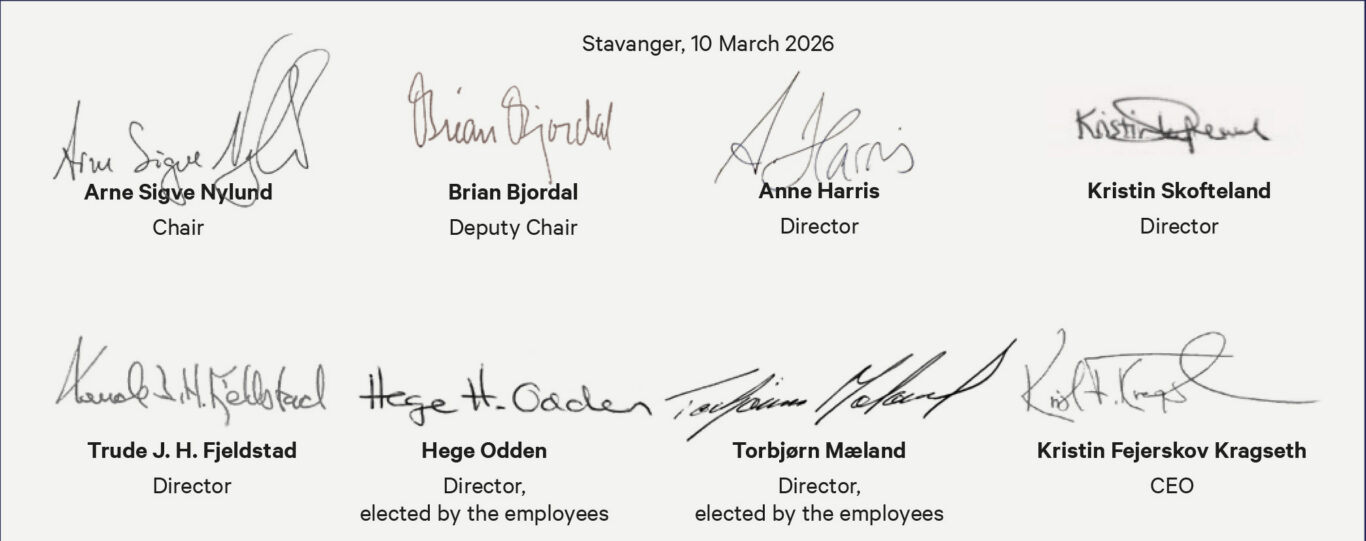
The board of Petoro AS consists of Arne Sigve Nylund (chair), Brian Bjordal (deputy chair), Kristin Skofteland, Trude J. H. Fjeldstad and Anne Harris as shareholder-elected directors. Hege Odden and Torbjørn Mæland were elected by the employees.
Directors and officers liability insurance has been taken out on commercial terms. This insurance covers the insured’s legal liability for economic loss incurred by virtue of their office, within the framework of relevant terms and conditions.
Reference is otherwise made to Chapter 4 Management and control under Corporate governance.



PETORO AS
Share capital and shareholder
Petoro AS was established as part of the restructuring of the state’s oil and gas activities in 2001, when Equinor (previously Statoil) was partially privatised and management of the SDFI was assigned to Petoro AS. The company’s operations are governed by Chapter 11 of the Petroleum Act. The company’s general meeting is the Ministry of Trade, Industry and Fisheries.
Petoro’s share capital at 31 December 2025 was NOK 10 million, distributed among 10,000 shares owned by the Ministry of Trade, Industry and Fisheries on behalf of the Norwegian state. Petoro’s business office is in Stavanger.
Net income and allocations
Petoro AS maintains separate accounts for all transactions relating to participating interests in the joint ventures. Revenue and expenses from the SDFI portfolio are kept separate from day-to-day operation of the company. Cash flow from the portfolio is transferred to the central government’s own accounts with Norges Bank. Accounts for the portfolio are presented both on the cash basis used by the government and in accordance with the Norwegian Accounting Act and Norwegian generally-accepted accounting principles (NGAAP).
Funds for operating Petoro AS are provided by the state, which is directly responsible for the contractual obligations incurred by the company. NOK 452 million was appropriated for the company’s ordinary operations in 2025, compared with NOK 399 million in 2024.
Total expenses in 2025 were within the framework of the Board’s approved budget, the company’s appropriation and allocation letter. The net income for Petoro AS totalled NOK 11.7 million. The board proposes that this profit be transferred to other equity. Including net loss for the year, other equity amounted to NOK 45.6 million as of 31 December 2025.
Pursuant to Section 3-2a of the Norwegian Accounting Act, the board affirms that the annual accounts for the portfolio and the company provide a true and fair picture of the company’s assets and obligations, financial position and results of the business, and that the annual accounts have been prepared under the assumption that the company is a going concern. The company has satisfactory equity and low financial risk.
Prospects
The ongoing conflict in the Middle East has contributed to increased geopolitical tension and reinforced uncertainty in international energy markets. Developments have already influenced oil and gas prices and underline how vulnerable the markets are to events in politically unstable regions. Going forward, the oil and gas industry will continue to face this type of risk, and significant price fluctuations must be expected as a result of geopolitical instability and changing market conditions.
There has long been broad political agreement in Norway to further develop oil and gas activities on the NCS. At the same time, there are increased expectations in society for how the companies can help solve societal challenges, and the oil and gas industry is expected to contribute to energy security in Europe and reduce its greenhouse gas emissions.
There are still considerable quantities of remaining oil and gas resources on the NCS that can provide a basis for production, activity and value creation over the long term. According to the Norwegian Offshore Directorate’s last resource estimate, 56 per cent of the overall resources have been produced. There is uncertainty associated with future production forecasts, and the Norwegian Offshore Directorate has prepared three potential scenarios for future oil and gas production leading up to 2050. All show that production will decline moving forward. At the same time, there is a substantial range of outcomes, depending on exploration activity, technology development and the willingness and ability to invest.
Despite that demand for gas in the EU is expected to decline over time, there will still be a need for gas for many years to come. Gas production from the NCS is lower than the expected import needs in Europe in all of the Norwegian Offshore Directorate’s scenarios. Norwegian gas is expected to be competitive with low costs and low emissions from production and transport. This is why it is important to maintain investments in exploration and recovery to bolster Norway’s role as a predictable, stable and safe energy supplier for Europe.
Petoro will continue its efforts to maintain the shelf’s competitiveness. In order for oil and gas from the NCS to remain competitive and relevant in the future, we will need to continue producing it at low costs and with low greenhouse gas emissions. The Norwegian authorities must contribute with predictable and stable framework conditions, and access to exploration acreage. Companies, on the other hand, must be willing to take the necessary risk and invest in innovation and technology development. Over the next few years, it will be particularly important to thoroughly explore the exploration potential in the Barents Sea. By maintaining investments in exploration and production, Norway will remain a predictable, stable and safe energy supplier for Europe over the longer term as well. As a key player with a long-term perspective, Petoro will contribute to this.
Mature fields are the core of the SDFI portfolio. These fields constitute the greatest value and have the greatest potential for new reserves. Petoro is working to map the resource base, drill new wells and implement other improved recovery measures with low emissions on operating fields. A number of new drilling targets have been identified on the fields, but the drilling pace on the fixed drilling installations is low compared with previously achieved results.
With its large portfolio, Petoro plays an important role in finding solutions across fields and discoveries that provide greater opportunities and value than solutions within each individual licence. Moving forward, a number of fields and further development projects will be matured toward an investment decision. These projects include both new discoveries and further developments of existing fields.
As the primary owner of the key gas infrastructure, Petoro works in close cooperation with the operator Gassco and users of the gas infrastructure to ensure that the infrastructure remains competitive, safe and reliable.
Oil and gas activities are expected to continue on the NCS with a long-term perspective and low greenhouse gas emissions. The Government has started working on a new White Paper on Petroleum Policy. This could stake out a course and create predictability for the industry, and will be an important piece of the puzzle in 2026.